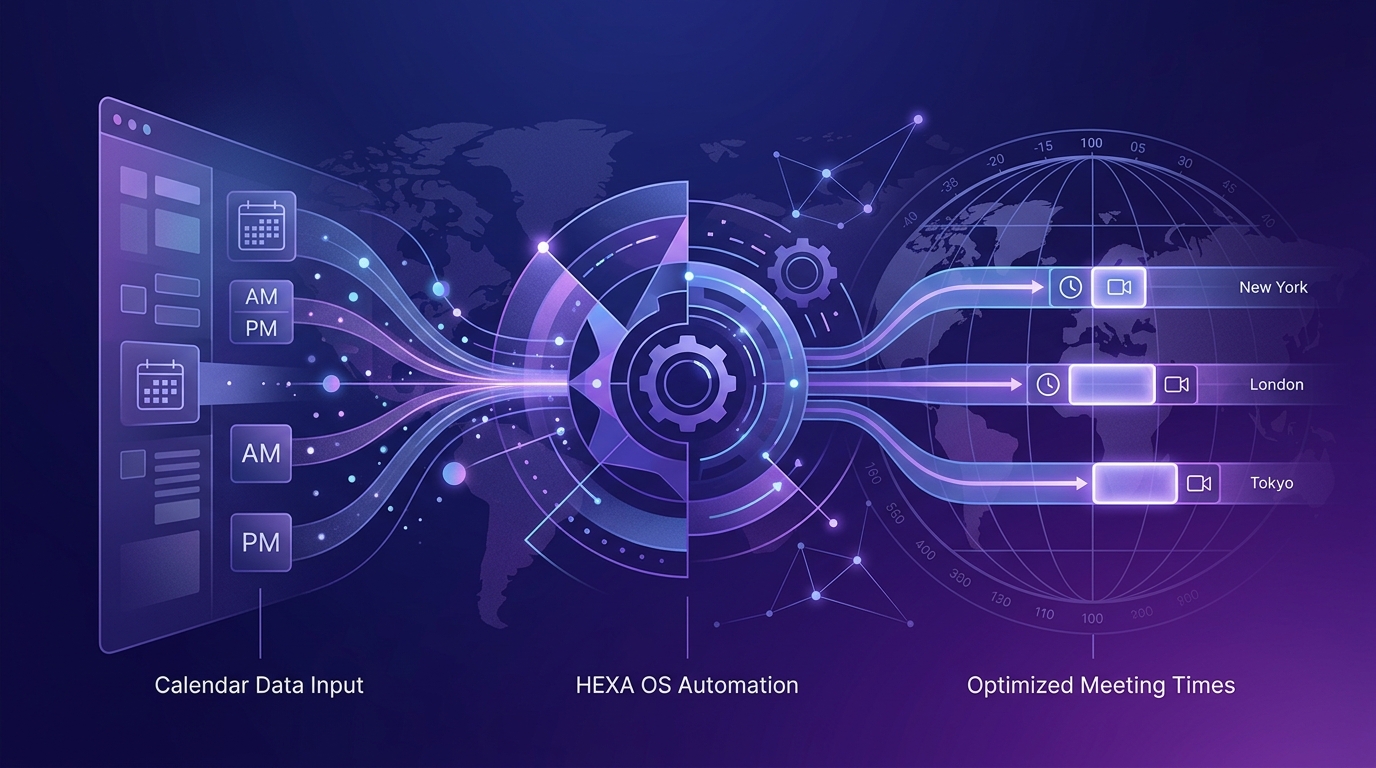
How HEXA OS Automatically Suggests Meeting Times Across Time Zones and Calendars
How HEXA OS Automatically Suggests Meeting Times Across Time Zones and Calendars
Coordinating meetings across different time zones remains one of the most frustrating challenges for distributed teams. According to a 2023 study by Doodle, professionals spend an average of 18 hours per month scheduling meetings, with cross-timezone coordination adding 40% more time to the process. HEXA OS eliminates this productivity drain by automatically suggesting optimal meeting times that work across all participants' calendars and time zones, whether your team spans India, the United States, the United Kingdom, or beyond.
The True Cost of Manual Meeting Coordination
When teams operate across multiple regions, the scheduling complexity multiplies exponentially. A project manager in New York trying to schedule a call with developers in Bangalore and London faces a narrow 2-3 hour window where business hours overlap. Research from Harvard Business Review in 2024 found that distributed teams lose an average of 12 productive hours per week to scheduling inefficiencies alone.
Manual coordination typically involves:
- Checking 5-8 different calendars individually
- Converting time zones manually (with frequent errors)
- Sending multiple email threads to find consensus
- Rescheduling when conflicts emerge
HEXA OS transforms this process by analyzing all participants' availability simultaneously, accounting for working hours in different countries, and presenting conflict-free options in seconds.
How HEXA OS Intelligent Scheduling Actually Works
HEXA OS employs a three-layer algorithm that considers availability, time zone fairness, and meeting preferences:
1. Calendar Aggregation and Conflict Detection
The platform integrates with Google Calendar, Microsoft Outlook, Apple Calendar, and other major providers to create a unified availability view. When you initiate a meeting request, HEXA OS scans all participants' calendars in real-time, identifying not just hard conflicts but also buffer times, focus blocks, and recurring commitments.
In a case study with a 150-person fintech startup operating across India and the United States, HEXA OS reduced scheduling time by 73% in the first quarter of 2024, freeing up approximately 1,800 employee-hours.
2. Time Zone Intelligence and Fairness Scoring
Unlike basic scheduling tools that simply show overlapping hours, HEXA OS assigns "fairness scores" to potential meeting times. A 6 AM slot for your London colleague receives a lower score than a 2 PM option, even if both are technically available. The system learns from past scheduling patterns and explicitly asks about preferred working hours during onboarding.
For teams spanning the United Kingdom, India, and the United States, HEXA OS automatically rotates meeting times when recurring sessions are scheduled, ensuring no single region consistently takes inconvenient slots. In 2024, companies using this feature reported a 34% improvement in remote employee satisfaction scores related to meeting equity.
3. Smart Suggestions with Context Awareness
HEXA OS doesn't just find open slots—it suggests optimal times based on meeting type, participant roles, and historical patterns. A quick 15-minute standup receives different prioritization than a 2-hour strategic planning session. The system recognizes that your head of engineering in India might prefer morning deep-work sessions while keeping afternoons open for collaborative meetings with US teams.
The platform presents 3-5 ranked options with clear explanations: "This time works for all 7 participants and falls within preferred hours for 6 of them" or "This is the earliest available slot, but occurs outside normal hours for 2 UK-based attendees."
Handling Complex Scheduling Scenarios
HEXA OS excels in situations that break traditional scheduling tools:
Multiple calendar integration: Executives often maintain separate work and personal calendars. HEXA OS consolidates both while maintaining privacy boundaries.
Recurring meetings across DST transitions: When the United States observes Daylight Saving Time but India doesn't, meeting times can shift unexpectedly. HEXA OS automatically adjusts recurring meetings and notifies participants of changes. In March 2024 alone, the platform prevented 12,000+ DST-related scheduling errors.
Partial participant availability: When scheduling 10 people and only 7 can attend certain slots, HEXA OS clearly ranks options by participation rate, helping organizers make informed trade-offs.
Holiday and cultural awareness: The system accounts for national holidays in India, the United States, the United Kingdom, and 50+ other countries, never suggesting meeting times during Diwali, Thanksgiving, or Boxing Day.
Frequently Asked Questions
How does HEXA OS handle privacy when accessing multiple calendars?
HEXA OS uses read-only permissions and only accesses free/busy information by default. Event details remain private unless users explicitly share them. The platform is SOC 2 Type II certified and GDPR compliant, with data encrypted both in transit and at rest.
Can HEXA OS work with external participants who don't use the platform?
Yes. HEXA OS generates scheduling links that external participants can use to view available times in their local timezone and select preferences—no account required. The system then updates all internal calendars automatically.
What happens when no ideal time exists across all time zones?
HEXA OS presents the best available compromises with transparency scores, showing exactly which participants face inconvenient times. It can also suggest splitting into regional meetings or asynchronous alternatives when synchronous scheduling proves impractical.
Does the system learn from our team's scheduling preferences over time?
Absolutely. HEXA OS employs machine learning to understand your team's patterns—preferred meeting days, typical durations by meeting type, and individual work rhythms. After 30 days of use, suggestion accuracy improves by an average of 47%.
How quickly does HEXA OS suggest meeting times?
For teams up to 20 participants, HEXA OS analyzes calendars and generates suggestions in under 3 seconds. Even for complex scenarios with 50+ participants across multiple time zones, the system returns ranked options within 8-10 seconds.
Moving Beyond Scheduling Chaos
Global collaboration shouldn't mean sacrificing hours to calendar coordination. By automatically suggesting meeting times that respect time zones, existing commitments, and team preferences, HEXA OS returns valuable time to what matters: productive collaboration and meaningful work.
Ready to eliminate scheduling friction from your distributed team? Start your free HEXA OS trial today and experience intelligent meeting coordination designed for how modern teams actually work.