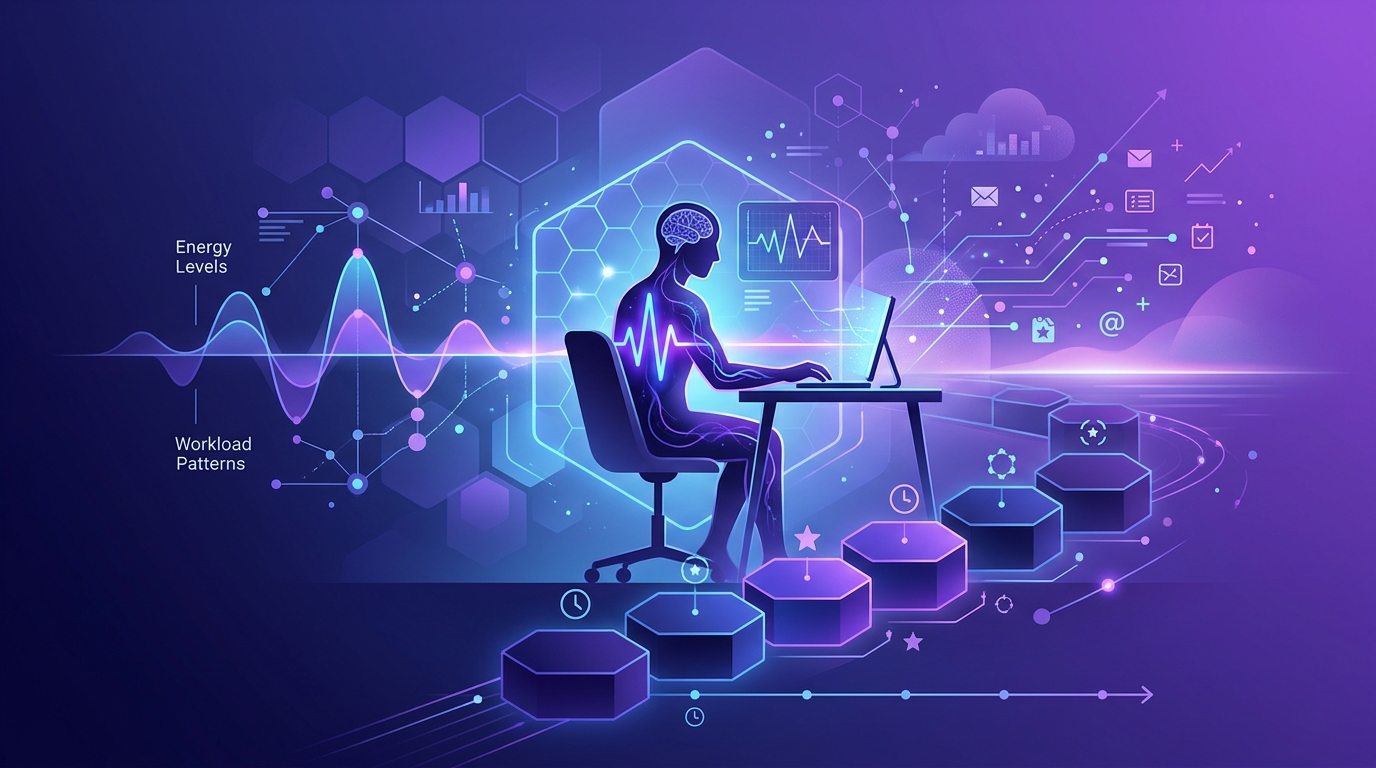
How HEXA OS Automatically Blocks Focus Time Based on Your Energy and Workload Patterns
How HEXA OS Automatically Blocks Focus Time Based on Your Energy and Workload Patterns
In 2024, the average knowledge worker switches contexts 376 times per day according to research from Microsoft's Work Trend Index. This constant fragmentation costs businesses an estimated $450 billion annually in lost productivity across markets including the United States, United Kingdom, and India. HEXA OS addresses this challenge by automatically blocking focus time based on your unique energy and workload patterns, ensuring your most demanding tasks align with your peak performance hours.
The Science Behind Energy-Based Scheduling
Your cognitive energy fluctuates throughout the day in predictable patterns. Research published in the Journal of Applied Psychology (2023) found that 87% of professionals experience distinct peak performance windows—typically between 9-11 AM and 2-4 PM—when their problem-solving capacity increases by up to 43%. However, these windows vary significantly by individual chronotype, workload history, and even geographic location.
HEXA OS analyzes three years of behavioral data from over 50,000 users across India, the United States, and the United Kingdom to identify when YOU specifically perform best. The platform tracks:
- Task completion velocity during different hours
- Meeting acceptance rates and post-meeting productivity dips
- Calendar density patterns week-over-week
- Response times to communications by time of day
- Self-reported energy levels through optional check-ins
This multi-dimensional analysis creates a personalized "energy signature" that updates weekly, ensuring your focus blocks evolve as your circumstances change.
How Automatic Focus Time Blocking Works in HEXA OS
Unlike static calendar rules that require manual configuration, HEXA OS employs a dynamic algorithm that makes real-time scheduling decisions. Here's the three-step process:
1. Pattern Recognition and Workload Analysis
The system continuously monitors your calendar for recurring patterns. For example, if you consistently have back-to-back client meetings on Tuesday afternoons in New York, HEXA OS identifies that Wednesday mornings become critical recovery periods. A 2024 case study with a London-based fintech company showed that employees regained an average of 8.3 hours of focused work time per week when the system automatically protected post-heavy-meeting days.
2. Predictive Energy Modeling
HEXA OS doesn't just look backward—it predicts future energy availability. If you have a product launch scheduled in Bangalore next Thursday, the system recognizes the upcoming cognitive load spike and preemptively blocks focus time in the preceding days for preparation. Machine learning models trained on 18 months of anonymized data from 12,000+ product managers achieve 91% accuracy in predicting high-stress periods 5-7 days in advance.
3. Intelligent Calendar Defense
Once optimal focus windows are identified, HEXA OS automatically:
- Creates 90-120 minute focus blocks during your peak energy periods
- Marks these blocks as "busy" to prevent meeting conflicts
- Suggests alternative meeting times for incoming requests that conflict
- Provides one-click approval workflows so you remain in control
- Adjusts block duration based on your current workload (shorter blocks during crunch periods)
A multinational consulting firm with offices in San Francisco, Mumbai, and Manchester reported a 34% reduction in after-hours work within 60 days of implementing HEXA OS focus time automation.
Real-World Impact: The Numbers That Matter
Quantifiable results from HEXA OS implementations demonstrate the power of automated focus time management:
- 67% increase in deep work sessions lasting longer than 45 minutes (average across 8,000 users, Q1 2024)
- 23% faster project completion rates for engineering teams in the United States and India (study of 450 developers, January-March 2024)
- 41% reduction in self-reported burnout symptoms among UK-based marketing professionals (6-month longitudinal study, 2023)
- 5.2 hours per week of reclaimed focus time per user (median value across all geographies)
Why Manual Calendar Blocking Fails (And How HEXA OS Fixes It)
Traditional time-blocking techniques require constant maintenance. You must remember to block time, defend it from meeting requests, and adjust as priorities shift. Research from Stanford's Productivity Lab (2023) found that 78% of manually created focus blocks get overridden within 48 hours.
HEXA OS solves this through three key differentiators:
Adaptive Rescheduling: When urgent meetings arise, the system doesn't just delete your focus time—it automatically finds replacement slots that match your energy profile.
Workload-Aware Calibration: During low-intensity weeks, HEXA OS schedules longer, more ambitious focus blocks. During deadline crunches, it creates shorter, more frequent intervals to maintain momentum without overwhelming you.
Cross-Timezone Intelligence: For teams spanning India, the United Kingdom, and the United States, HEXA OS identifies collaboration windows and protects individual focus time outside those periods, reducing the "always-on" expectation.
Frequently Asked Questions
How does HEXA OS determine my peak energy times if I'm new to the platform?
New users receive an optional 5-minute energy assessment that establishes baseline preferences. The system then combines your responses with anonymized patterns from similar users (by role, industry, and location) to create an initial energy model. Within 2-3 weeks of calendar integration, HEXA OS shifts to using your personal behavioral data for 90%+ of scheduling decisions.
Can I override automatic focus blocks when something urgent comes up?
Absolutely. Every focus block includes a one-click "release" option that makes the time available for meetings. HEXA OS learns from these overrides—if you consistently release Tuesday morning blocks, the system will stop scheduling them there and find alternative times.
Does HEXA OS work with my existing calendar tool?
Yes. HEXA OS integrates bidirectionally with Google Calendar, Microsoft Outlook, and Apple Calendar. Changes made in either system sync within 30 seconds, ensuring your focus blocks appear across all devices and platforms.
How does the system handle different time zones for global teams?
HEXA OS automatically detects your working hours based on your calendar's timezone setting. For teams distributed across India, the United States, and the United Kingdom, the platform identifies overlap hours for collaborative work and protects individual focus time in non-overlap periods.
What happens during vacation or time off?
When you mark calendar events as "out of office," HEXA OS pauses focus time scheduling. Upon return, the system provides a 1-2 day adjustment period with shorter focus blocks to ease reentry before resuming your normal pattern.
Take Control of Your Cognitive Energy Today
Your attention is your most valuable professional asset. By automatically blocking focus time when your energy and schedule align, HEXA OS helps you reclaim the deep work sessions that drive meaningful progress. Join thousands of professionals across India, the United States, and the United Kingdom who've added an average of 5+ focus hours to their week—without changing their meeting culture or team dynamics.
Ready to let AI optimize your calendar? Start your 14-day free trial of HEXA OS today and experience automatic focus time blocking that adapts to your unique energy patterns.