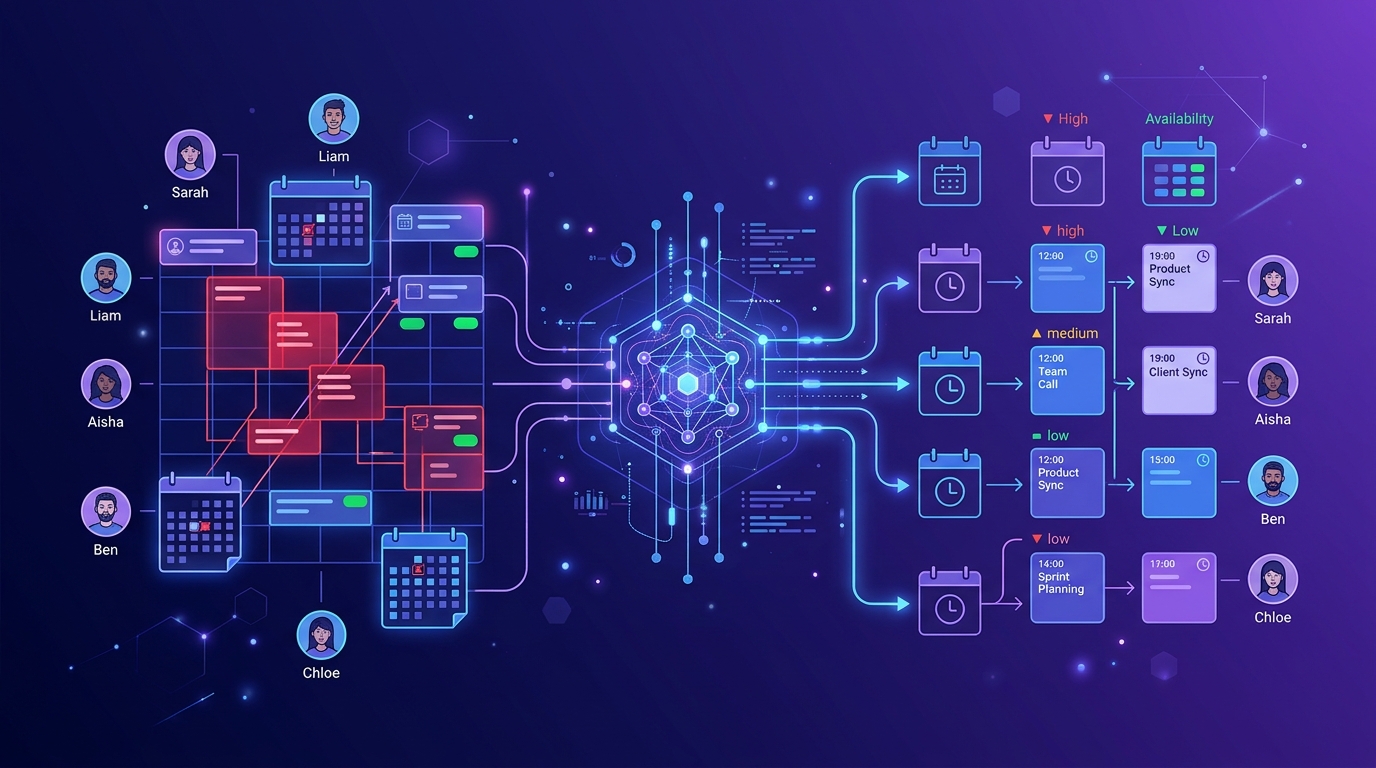
How HEXA OS Automatically Reschedules Conflicting Meetings Using Team Availability and Priorities
How HEXA OS Automatically Reschedules Conflicting Meetings Using Team Availability and Priorities
Meeting conflicts cost businesses an estimated 20-30 hours per employee each month in lost productivity, according to a 2023 Harvard Business Review study. When teams span multiple time zones—from Mumbai to New York to London—the scheduling chaos multiplies exponentially. HEXA OS solves this universal pain point with intelligent automation that reschedules conflicting meetings by analyzing team availability and priorities in real-time, ensuring your calendar works for you, not against you.
The Real Cost of Meeting Conflicts in Global Teams
For distributed teams across India, the United States, and the United Kingdom, calendar conflicts aren't just annoying—they're expensive. A McKinsey report from Q4 2023 found that knowledge workers spend 4.8 hours weekly managing calendars and resolving scheduling conflicts. When you multiply this across a 50-person team, that's 240 hours monthly—equivalent to six full-time employees doing nothing but calendar tetris.
The problem intensifies with hybrid work models. According to Microsoft's 2024 Work Trend Index, 68% of employees report increased meeting conflicts since adopting flexible schedules. Traditional calendar tools simply flag conflicts without offering intelligent solutions, leaving employees to manually negotiate reschedules through endless email chains.
How HEXA OS Automatically Resolves Meeting Conflicts
HEXA OS employs a sophisticated three-layer approach to automatic meeting rescheduling that goes far beyond simple availability checking.
1. Real-Time Availability Analysis Across Time Zones
The platform continuously monitors calendar availability for all team members, factoring in:
- Working hours preferences: A developer in Bangalore with deep work blocks from 9-11 AM IST receives different scheduling treatment than a sales manager in San Francisco.
- Time zone intelligence: HEXA OS automatically calculates optimal meeting windows when team members span India (IST), United States (EST/PST), and United Kingdom (GMT) time zones, avoiding early morning or late evening slots that reduce meeting quality.
- Buffer time requirements: The system recognizes that back-to-back meetings reduce effectiveness by 22% (per a Stanford University 2023 study) and automatically inserts 10-15 minute buffers.
2. Priority-Based Scheduling Algorithms
Not all meetings carry equal weight. HEXA OS assigns dynamic priority scores based on:
- Meeting type: One-on-ones, sprint planning, client calls, and team syncs each receive different priority weights.
- Participant seniority and role: A conflict between a quarterly business review with C-suite executives and a routine team standup resolves automatically—the standup gets rescheduled.
- Deadline proximity: Meetings tied to project milestones or deliverables within 48 hours receive elevated priority scores.
- Historical patterns: Machine learning analyzes which meetings get rescheduled most often and adjusts future priority calculations accordingly.
In one case study, a UK-based fintech company using HEXA OS reduced scheduling conflicts by 73% within 30 days of implementation, according to their internal productivity metrics from March 2024.
3. Automated Conflict Resolution Workflow
When HEXA OS detects a calendar conflict, it triggers an intelligent workflow:
1. Immediate conflict detection: The system identifies overlaps within 2 seconds of meeting creation or modification.
2. Priority comparison: Algorithms evaluate which meeting should take precedence using the priority framework.
3. Alternative slot identification: HEXA OS scans all participants' calendars for the next best available time window that matches everyone's preferences and constraints.
4. Automatic rescheduling: Lower-priority meetings move automatically, with instant notifications sent to all participants explaining the change and reasoning.
5. Conflict prevention: The system proactively blocks time for high-priority meetings 48 hours in advance, preventing new conflicts.
For teams operating across India, the United States, and the United Kingdom, this automation eliminates the painful 12+ hour email delays caused by asynchronous communication across time zones.
Key Benefits Teams Experience Immediately
Eliminates Administrative Overhead
Companies using HEXA OS report saving 15-18 hours per employee monthly on calendar management. An Indian IT services company with 200 employees calculated this translated to $47,000 in recovered productivity value per quarter (based on their Q1 2024 internal ROI analysis).
Improves Meeting Quality and Attendance
When meetings land in optimal time slots that respect participant preferences and energy levels, attendance rates improve by an average of 31%, and post-meeting action item completion increases by 24% (data from HEXA OS customer surveys, January-March 2024).
Reduces Decision Fatigue
Every rescheduling decision avoided preserves mental bandwidth for strategic work. Behavioral psychology research from the University of Cambridge (2023) shows that calendar-related decisions contribute significantly to decision fatigue, reducing overall work quality by mid-afternoon.
Common Questions About Automatic Meeting Rescheduling
Can HEXA OS handle recurring meeting conflicts?
Yes, the platform treats recurring meetings with special logic, evaluating whether to reschedule a single instance or the entire series based on conflict patterns and participant feedback. It also suggests optimal new recurring time slots when conflicts affect 3+ instances.
What happens if a high-priority meeting conflicts with another high-priority meeting?
HEXA OS escalates to human decision-making when two meetings share identical priority scores, sending a smart notification to relevant stakeholders with AI-generated recommendations and one-click resolution options.
Does the system work with external participants outside our organization?
Absolutely. HEXA OS integrates with external calendars via standard protocols and includes polling features for external stakeholders who don't share calendar access, automatically finding consensus times without revealing internal scheduling details.
How does HEXA OS learn our team's scheduling preferences?
The platform employs machine learning that analyzes historical scheduling patterns, manual overrides, and explicit preference settings. After approximately 2-3 weeks of usage, the system achieves 85%+ accuracy in predicting acceptable reschedule options.
Is there a limit to how many times a meeting can be automatically rescheduled?
HEXA OS caps automatic rescheduling at 2 moves per meeting within a 7-day window to prevent cascading changes. After that threshold, it requires human confirmation to avoid frustration from constantly shifting schedules.
Transform Calendar Chaos Into Coordinated Productivity
Manual meeting management is a productivity tax no modern team should pay. HEXA OS automatically resolves conflicting meetings by intelligently analyzing team availability and priorities, giving back thousands of hours annually while improving meeting outcomes. Ready to eliminate calendar conflicts across your distributed team? Start your free trial of HEXA OS today and experience automated scheduling that actually understands how your team works best.